
The market is becoming the game. Inside the convergence of trading, prediction markets and iGaming.
Crash games simplified casino mechanics. Prediction markets made opinions tradable. Crypto made markets run all day. We researched 47 companies across all four worlds to test whether a new category is forming where they meet, and who is already standing in it.
Four industries are starting to look surprisingly similar
For most of their history, casino gaming, sports betting, financial trading and prediction markets grew up in separate buildings, under separate regulators, for what looked like separate customers. In 2026 the walls between them are thin enough to see through.
Robinhood, a stock-trading app, earned $156 million from event contracts in the second quarter of 2026, more than the $100 million it earned from crypto. Its customers traded 13.6 billion contracts in the quarter, ten times the year before.11 Coinbase and Webull embed Kalshi contracts, including hourly Bitcoin over/under markets, inside brokerage apps.46
The traffic runs the other way as well. Roobet launched prediction markets in May 2026 and BC.GAME added a Prediction Center powered by Polymarket a month later, with Bitcoin, Ether and Solana price markets sitting one tab away from Crash and Plinko.3534 Rollbit has run leveraged crypto futures inside a Curaçao-licensed casino since 2023,33 and Evolution sells a game called Stock Market in which players bet up or down on a chart drawn by a random number generator.18
The customer is converging too. Kalshi says roughly 60% of its users are aged 18 to 34 and about three quarters are men.12 Morning Consult finds 71% of prediction-market users are men, disproportionately under 45.13 In Great Britain, 18 to 24 year olds are the age group least likely to gamble at all, yet those who do play the widest range of products, an average of 3.6 activities against 1.7 for the oldest group.43 Deloitte reports that Gen Z spends 54% more time on social and creator content than the average consumer and correspondingly less on television.44 The common thread is participation: younger audiences want to act on what they watch, whether it is a match, a chart or a stream.
If the same person is a crypto trader on Monday, a prediction-market user on Tuesday and a crash-game player on Friday, what happens when the market itself becomes the game?
Crash games proved players want speed
Crash games are the clearest evidence of what this audience wants from casino content. Spribe reports that Aviator now has 77 million monthly players, more than 400,000 bets a minute, about €160 billion wagered in 2025 and distribution through more than 5,500 operators.14 Those are company figures, but the direction is not in dispute: 121 of the 378 crash titles catalogued by one tracker were released in 2025 alone.16
The design lessons are now industry standard: Pragmatic Play sells High Flyer on five seconds between flights,15 Evolution's Red Baron runs a ten-second window, Hacksaw treats instant-win as a content pillar. Rounds are short, rules fit in a sentence, the multiplier is the drama, and the one decision, when to cash out, makes the player a participant.
Two caveats. Crash is bigger in Latin America, Africa and crypto casinos than in regulated Europe, where SOFTSWISS estimates it at about 1.1% of digital casino GGR.17 And the event at the heart of every crash game is abstract: a random number with a story painted on it. Spribe's own chief commercial officer argued in August 2026 that mechanics do not build community, brand does.19 That is a candid admission about the format's ceiling. Nothing outside the game gives the curve meaning, so operators manufacture it with hosts, chat and sponsorships.
Prediction markets proved people want to play their opinions
Prediction markets had the breakout year that crash games had five years earlier. Kalshi's notional volume was $23.8 billion for all of 2025; it traded more than $41 billion in July 2026 alone.21 Pew, using data from The Block, puts Kalshi and Polymarket's combined volume at roughly $24 billion a month by April 2026, up from under $5 billion the previous September.3
The idea that drove the growth is simple: people enjoy converting an opinion about the future into a position. What the volume data reveals is which opinions they most enjoy converting. Polymarket's Bitcoin Up or Down markets, which settle every five and fifteen minutes, reached $4 billion in cumulative volume and $153 million a day by April 2026.4 Eilers and Krejcik estimate that about 8% of all Polymarket volume is now five-minute Bitcoin.5 Kalshi's fifteen-minute Bitcoin contract creates 96 new markets a day, around the clock, settled on a sixty-second average of a CF Benchmarks index.6 Crypto is a minority of Kalshi's overall volume, about 7%, but 86% of that crypto volume is Bitcoin, most of it in the shortest contracts.37
Through an iGaming lens these are hard to distinguish from instant games. A contract that hovers near 50 cents and pays $1 or nothing every fifteen minutes is, as one analyst put it, functionally a binary option,7 and a gambling-trade publication compared the five-minute market directly to crash.5 Nobody at these companies set out to build casino content. Their users found it anyway.
The same data shows the limits. A Stanford and SMU study found 821 accounts extracted about $8.2 million by pushing the Binance price in the final seconds before settlement, with retail absorbing 93% of the losses; Polymarket moved to time-weighted Chainlink settlement on 7 August 2026 in response.8 Bloomberg counted more than 100,000 Polymarket accounts with four-figure losses and found that around 5% of wallets, mostly bots, generate three quarters of the volume.9 Some 45,000 markets have never traded.10 Most contracts settle in days or months on an order book with maker and taker fees. Prediction markets are financial venues that happen to be entertaining, not entertainment products.
Crypto trading proved markets can be entertainment
Perpetual futures are the largest speculative product on earth by turnover: CoinGecko puts 2025 centralised-exchange volume at $85.3 trillion, with Hyperliquid alone clearing close to $3 trillion on-chain.2148 The engagement machinery is borrowed from games: Binance's Traders League has daily leaderboards and team brackets, Hyperliquid distributed its token through a points system that rewarded volume and referrals, Bybit funds six-figure leaderboard prize pools.48
Exchanges have tested the impulse directly. Binance ran Futures Battle, a one- and five-minute up/down game for points, since discontinued.23 OKX's Telegram mini-app asks players to call moon or doom on Bitcoin's next five seconds.24 Kraken gives prizes for a free ten-second higher/lower call.25 Exchanges know the short price call is compelling, and they keep shipping it as a promotion rather than a product, because as a product it would be a binary option.
But trading is still too complicated to be a game
Ask a new user to open a perpetual position and the friction is immediate: KYC or a wallet, a deposit on the right chain, cross or isolated margin, an order type, a leverage slider, a liquidation price. At 50x a move of about 1.5% wipes the position out. On 10 October 2025 roughly $19 billion was liquidated across 1.6 million traders in a single day.22 OKX now sells a Simple Option whose entire pitch is that the user cannot be liquidated.27
Regulators have measured what happens when trading is made to feel like a game. The UK FCA's 2025 review of twelve trading apps found that users exposed to the most gamified features traded seven times more often and were materially more likely to suffer large losses.26 That leaves the industry with an awkward truth. The products winning adoption in 2026, one-dollar yes/no contracts, hourly over/under markets, fixed-loss options, all strip complexity away, and stripping complexity away is where regulators say trading turns into gambling.
So the design question is not how to put trading inside a casino. It is what remains when you keep the excitement of market speculation and remove the apparatus of trading. The map below shows who is already working on that.
The competitive map
We scored 47 companies and products on two axes with one rubric. Financial relevance: use of live prices, real exposure, news relevance, trading mechanics. Gaming experience: simplicity, speed, visual feedback, repeatability, gamification. Bubbles are equal because no credible common scale metric exists across casinos, exchanges and studios.
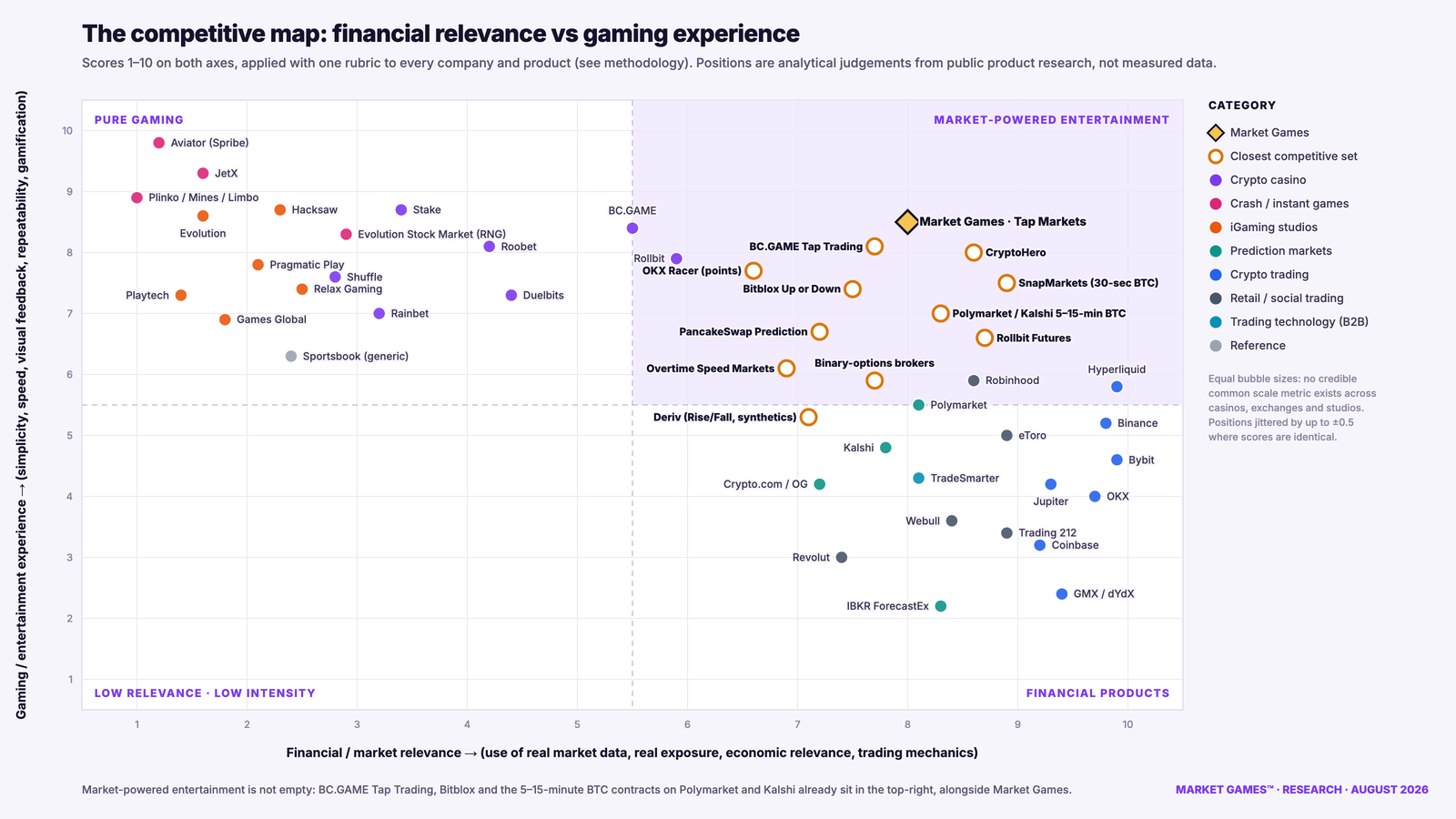
The map shows two dense clusters with almost nothing between them. Every established iGaming studio sits top-left: enormous entertainment value, no connection to anything outside the game. Every exchange and brokerage sits bottom-right: total market relevance, an experience built for managing positions. Crypto casinos drift towards the centre only because they have bolted prediction markets and futures onto their lobbies.
The top-right, market-powered entertainment, is not empty. BC.GAME launched a game in September 2025 called Tap Trading, in which the player taps a multiplier block on a live price chart and wins if the price touches it before the block expires.28 Bitblox, an Isle of Man studio, sells fixed-odds Bitcoin up/down games with 60-second and 20-second rounds through aggregators such as 21VIRAL and Timeless Tech.2930 Blockchain.com launched SnapMarkets in May 2026, a 30-second Bitcoin call with streaks and a leaderboard that it does not offer in the US or UK.32 Then there are the five- and fifteen-minute contracts on Polymarket and Kalshi, Rollbit's futures desk, Deriv's Rise/Fall products,47 DeFi five-minute pools and the offshore binary-options brokers that never went away.
What is absent is just as telling. Not one tier-one studio, not Evolution, Pragmatic Play, Playtech, Hacksaw, Relax or Spribe, offers a game whose outcome is determined by a real market. The one real-price game we found on a major regulated-style operator, Bitblox's Up or Down Turbo at Sportsbet.io, is currently listed as disabled.31 That is a gap, but it is also a warning. The category's ancestors are binary options, and binary options were banned for retail customers by ESMA in 2018, by the FCA in 2019 as "gambling products dressed up as financial instruments", and by Israel in 2017, before the last regulated US venue switched off its binaries in December 2025.36375249 The top-right corner is thinly populated for a reason.
The missing product layer
Put the four industries side by side and a sequence appears. Crash games simplified casino mechanics. Prediction markets made opinions tradable. Crypto made markets run 24 hours a day. The step none of them has completed is turning those markets into games that a licensed casino operator can actually stock.
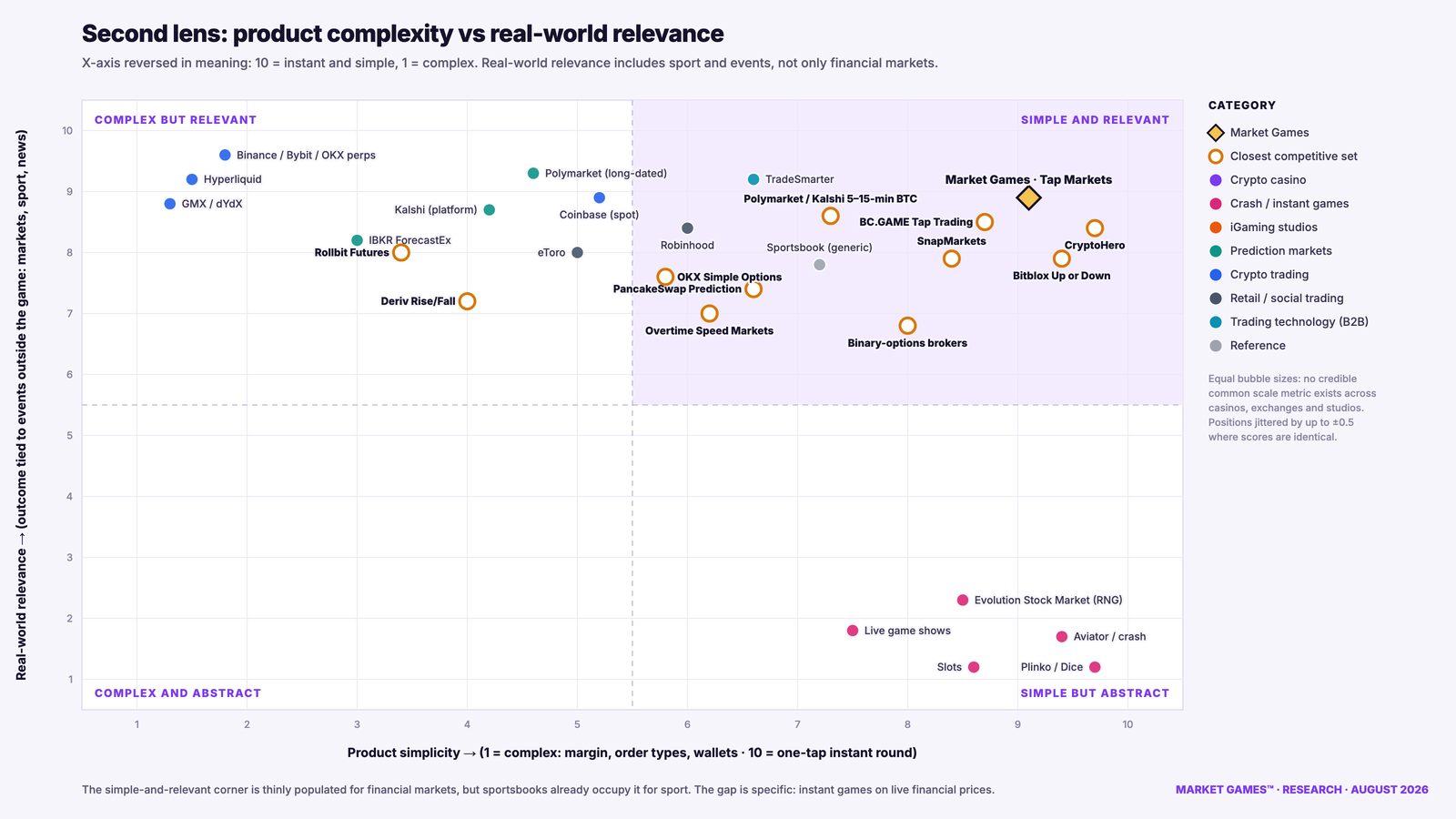
That is the shape of the gap. Demand is proven three times over: Aviator's speed, Polymarket's five-minute volume, the exchanges' price-call promotions. What is missing is the supply side for regulated iGaming: content certified by a testing laboratory, distributed through the aggregators and remote game servers operators already use, priced with a known return to player, and built so the outcome engine can change with the jurisdiction while the interface stays the same. A second lens makes the point. Plot simplicity against real-world relevance and sportsbooks already own the simple-and-relevant corner for sport; for financial markets it holds a handful of small studios and the fringe of prediction markets. It is one of the few places in gambling where the audience arrived before the industry.
From randomness to relevance
Traditional casino games create the event and then determine the outcome. A slot spins because you pressed the button; nothing in the world changed. Market-powered games invert that. The event is already happening, all day, on every screen the player owns, and the game turns a slice of it into a round.
The product thesis is that this connection produces a different kind of engagement. If Bitcoin moves 2% during a session, the player often knows why. If gold spikes after a rate decision, there is a story behind the candle. Markets contain the raw material games have to fabricate: uncertainty, momentum, reversals, countdowns and a narrative supplied by the news. We should be careful. We know of no controlled research showing that externally relevant outcomes are more engaging than abstract ones, and crash proves abstract can be very engaging. What the prediction-market data shows is that, given a five-minute horizon, people choose to speculate on a market they follow anyway. That is a strong hint, not a proof.
Market-powered games vs prediction markets vs trading
The distinctions matter commercially and legally. In trading, the user manages a financial position: ownership, leverage, margin, a liquidation price and a P&L that lives until they close it. In a prediction market, the user trades a contract on an outcome: shares priced between zero and one, an order book, a settlement date and early exit. In a traditional casino game, the user plays a predefined mechanic whose outcome is generated inside the game. In a market-powered game, market movement itself becomes the game mechanic: a round, a stake, a published payout and a result read from a price feed, with no position to manage and no contract to trade.
| Dimension | Casino | Crash | Prediction markets | Crypto trading | Market-powered games |
|---|---|---|---|---|---|
| Round speed | Seconds | Seconds | Minutes to months | Open-ended | Seconds to minutes |
| Simplicity | High | Very high | Medium | Low | High |
| Real-world relevance | None | None | Very high | Very high | High in real mode, none in synthetic mode |
| Market exposure | None | None | Yes, contract | Yes, position | None, fixed payout on market event |
| Entertainment value | High, proven | Very high, proven | Medium | Medium | High, unproven at scale |
| Financial complexity | None | None | Medium | High | Low |
| Mobile suitability | High | Very high | Medium | Medium | Very high |
| Repeatability | High | Very high | Low, except crypto shorts | High | Very high |
| Social potential | Medium | High, multiplayer | High, virality | High, leaderboards | Medium, untested |
| Player agency | Low | Medium, cash-out | High | Very high | Medium, choice of target and duration |
| Liquidity requirement | None, house | None, house | High, peer to peer | Very high | None, but house risk against a live market |
| Casino integration | Native | Native | Separate licence and venue | None | Native via RGS; certification path still forming |
The last two rows are where honesty is due. Market-powered games need no liquidity, but the house is exposed to a live market and to anyone with a faster feed. The latency arbitrage regulators cited when banning retail binaries, and that the Stanford study found on Polymarket, applies to any game settled on a live price. In this category risk management and feed integrity are not features; they are the product.
Why iGaming operators should pay attention
SOFTSWISS made the operator case bluntly in May 2026: prediction-market volume went from under $5 billion to $24 billion a month, and almost none of it flowed through traditional gambling operators.45 The audience operators want most has been building the habit somewhere else. Market-powered content is one of the few ways to serve it inside an existing lobby, wrapped in the operator's own wallet, KYC, bonusing and responsible-gambling tooling, with content that never sleeps and assets that need no explanation.
The regulatory picture is unsettled but it is not blank. The CFTC's June 2026 proposed rule defines gaming and would presumptively prohibit exchange-listed contracts on purely random outcomes.39 ESMA said in July 2026 that event contracts on MiFID Annex I underlyings such as indices, forex and commodities are financial instruments and fall under national binary-options bans.38 The UK Gambling Commission wrote in February 2026 that prediction markets meet the legal definition of gambling, most likely as a betting intermediary.40 Brazil requires every licensed online game to use an approved RNG with a minimum 85% return to player.41 GLI-19, the standard most casino games are certified against, explicitly excludes wagering on real-world events, which sits under GLI-33.42
Read together, those positions say one thing: the structure of the product decides its category. A casino game that uses market information, with a fixed payout, a published RTP and no exposure beyond the stake, is materially different from a financial instrument that provides market exposure, even if the two look alike on screen. The studios that succeed will be those whose architecture lets the outcome engine change with the jurisdiction: real market data where permitted, a certified RNG inside a real-market envelope where a gaming regulator requires one, a fully synthetic market where that is the only route. That flexibility, plus audited feed integrity and aggregator distribution, is a higher barrier than the idea, which anyone can copy in a weekend.
The Market Is The Game
This is the category Market Games is building, and we should be clear about where we sit on our own map. Tap Markets, our flagship, scores in the same top-right cell as BC.GAME's Tap Trading. The mechanic, tap a box on a live chart for a price range and a time window and win a multiplier if the market enters it, is not unique. What we are building is the studio layer underneath it.
Market Games is a B2B supplier of market-powered casino games: the player interacts with market movement through a simple mechanic, with no leverage, margin, order book, position or liquidation. The same interface runs on three outcome engines depending on the jurisdiction: real aggregated crypto-market data, a hybrid in which two external feeds set the envelope and a certified RNG generates movement inside it, or a fully synthetic certified market. Every Tap, market record and settlement is designed to be independently verifiable, the architecture we set out in our earlier article. Distribution is through API, RGS and aggregators, so the operator keeps the player, the wallet and the compliance stack. Tap Markets is one expression of the category; the same infrastructure supports our other titles and the mechanics still to come.
This research does not say the gap is enormous or that we are alone in it. It says demand has been demonstrated three times over, that regulated operators are the one channel where it is still unserved, and that the winners will be decided by certification, risk management and distribution rather than by who thought of it first. We take the behaviour, the visual language and the excitement of markets and turn them into gaming content. The market is the game.
Sources
- Sacra / DefiRate, Kalshi revenue, valuation and monthly volume series (Aug 2026). Supports: Kalshi monthly notional $6.6B Dec 2025, $29B to $41B mid-2026. defirate.com
- ChainCatcher (KalshiData), Kalshi 2025 volume $23.8B (4 Jan 2026). Supports: Kalshi 2025 annual notional. www.chaincatcher.com
- Pew Research Center, Trading volume on prediction markets has soared in recent months (27 May 2026). Supports: Combined Kalshi and Polymarket about $24B in April 2026; crypto 7% of Kalshi and 20% of Polymarket volume. www.pewresearch.org
- Yahoo Finance / Coinfomania, Polymarket hits $4B on 5-minute markets (9 Apr 2026). Supports: 5 and 15-minute BTC markets: $153M per day, $4B cumulative. finance.yahoo.com
- Casino Reports, This is your brain on five-minute Bitcoin markets (8 Jun 2026). Supports: Eilers and Krejcik estimate about 8% of all Polymarket volume is 5-minute BTC; crash-game comparison. www.casinoreports.com
- Prediction Markets Picks, Kalshi 15-minute Bitcoin (KXBTC15M): rules, settlement and edge (2026). Supports: 96 markets per day; CF Benchmarks 60-second settlement average. predictionmarketspicks.com
- Next Event Horizon, How Bitcoin markets are reshaping volume at Kalshi (20 Apr 2026). Supports: 86% of Kalshi crypto volume is BTC; contracts hover near 50 cents; binary-option critique. nexteventhorizon.substack.com
- Genfinity, Chainlink TWAP data streams now settle Polymarket 5 and 15-minute markets (12 Aug 2026). Supports: Manipulation study: 821 accounts, about $8.2M, retail 93% of losses; TWAP switch 7 Aug 2026. genfinity.io
- Yahoo Finance (Bloomberg), 100,000 Polymarket accounts booked four-figure losses (28 Apr 2026). Supports: Loss distribution; about 5% bot-like wallets account for 75% of volume. finance.yahoo.com
- Yahoo Finance (CNBC), 45,000 Polymarket markets recorded zero volume (Jun 2026). Supports: Long-tail illiquidity. finance.yahoo.com
- Fortune / Robinhood IR, Robinhood Q2 2026 results (29 Jul 2026). Supports: 13.6B event contracts; $156M event-contract revenue vs $100M crypto; 28.4M funded customers. investors.robinhood.com
- CBS News, Young men say they like their odds (8 Jun 2026). Supports: Kalshi users about 60% aged 18 to 34, roughly three quarters male. www.cbsnews.com
- Yahoo Finance, Young men flock to prediction markets (Morning Consult) (6 Jun 2026). Supports: 71% of prediction-market users are men, disproportionately under 45. finance.yahoo.com
- Tribuna (Spribe), Bukia outlines tech powering 77m monthly Aviator players (18 Feb 2026). Supports: Reported: 77M monthly players, 400,000+ bets per minute, about €160bn wagered in 2025, 5,500+ operators. tribuna.com
- Pragmatic Play, Pragmatic Play launches High Flyer (19 Sep 2024). Supports: Five seconds between flights. pragmaticplay.com
- Business of iGaming, Crash games boom (12 Jan 2026). Supports: 378 crash titles catalogued, 121 released in 2025. businessofigaming.com
- SOFTSWISS, Casino game types guide for operators (24 Mar 2026). Supports: Estimate: crash about 1.1% of European digital casino GGR; operators adding Aviator report 10%+ GGR uplift. www.softswiss.com
- LiveCasinoComparer, Evolution Stock Market Live review (n.d.). Supports: Evolution Stock Market: the RNG determines the value of the stock; no real stocks. livecasinocomparer.com
- OnlineGambling24, Spribe CCO: mechanics do not build community (24 Aug 2026). Supports: Spribe strategy statement on community versus mechanics. onlinegambling24.com
- Evolution AB, Interim report January to June 2026 (17 Jul 2026). Supports: Live revenue down year on year; RNG growth; game-show category strength. www.evolution.com
- CoinGecko, State of Crypto Perpetuals Report 2026 (21 May 2026). Supports: 2025 CEX perpetuals volume $85.3T; Hyperliquid share; 2026 slowdown. www.coingecko.com
- CoinGecko / CNBC, October 10, 2025 crypto crash explained (Oct 2025). Supports: About $19B liquidated across about 1.6M traders in 24 hours. www.coingecko.com
- Binance, Futures Battle FAQ and activity page (n.d.). Supports: 1 and 5-minute up/down points game; feature no longer available. www.binance.com
- The Block, OKX launches Bitcoin price guessing game OKX Racer (22 Jul 2024). Supports: 5-second moon/doom Telegram game for points. www.theblock.co
- Kraken, Introducing Price Predictor (2025). Supports: Free 10-second BTC higher/lower promotion. blog.kraken.com
- Finance Magnates (FCA), FCA review exposes concerns over push notifications and prize draws in trading apps (11 Apr 2025). Supports: High-DEP users trade 7x more; push notifications increase trades 11%. www.financemagnates.com
- OKX, Simple Option FAQ (n.d.). Supports: Premium-only risk, no liquidation product. www.okx.com
- PR Newswire, BC.GAME launches Tap Trading, a price-touch multiplier game for crypto markets (22 Sep 2025). Supports: BC.GAME Tap Trading mechanic, assets, existing Up/Down and High/Low games. www.prnewswire.com
- iGaming Business, 21VIRAL adds Bitblox crypto prediction games (25 Nov 2024). Supports: Bitblox distribution via aggregator; three BTC games. igamingbusiness.com
- Casino.org, Interview: Bitblox and the rise of crypto-powered prediction gaming (18 Feb 2025). Supports: Bitblox positioning, Isle of Man base. www.casino.org
- Sportsbet.io, Up or Down (Bitblox) (2026). Supports: 20-second BTC rounds; game listed as disabled. sportsbet.io
- CoinDesk, Blockchain.com launches SnapMarkets (6 May 2026). Supports: 30-second BTC up/down with streaks; not offered in US or UK; binary-option comparison. www.coindesk.com
- Datawallet, Rollbit review 2026 (25 Aug 2026). Supports: Rollbit Futures: up to 1000x against house index; outside gaming-licence scope. www.datawallet.com
- CryptoPotato (PR), BC.GAME launches Prediction Center powered by Polymarket (16 Jun 2026). Supports: Casino-embedded prediction markets including crypto price markets. cryptopotato.com
- CryptoSlate (PR), Roobet launches prediction markets (6 May 2026). Supports: First major crypto casino prediction-market launch. cryptoslate.com
- ESMA, ESMA agrees to prohibit binary options (27 Mar 2018). Supports: EU retail binary-options ban. www.esma.europa.eu
- FCA, FCA confirms permanent ban on binary options (29 Mar 2019). Supports: UK ban; "gambling products dressed up as financial instruments". www.fca.org.uk
- Yogonet (ESMA statement), ESMA warns some prediction contracts fall under binary options rules (9 Jul 2026). Supports: Contracts on MiFID Annex I underlyings are financial instruments. www.yogonet.com
- CFTC, Notice of proposed rulemaking on event contracts involving enumerated activities (10 Jun 2026). Supports: Definition of gaming; presumptive prohibition on purely random outcomes. www.cftc.gov
- Gambling.com (UKGC blog), Are prediction markets legal in the UK? (2026). Supports: UKGC: prediction markets meet the legal definition of gambling, likely as betting intermediary. www.gambling.com
- Demarest, SPA/MF publishes new regulations on fixed-odds betting (Brazil) (2024 to 2025). Supports: Approved RNG requirement; minimum 85% RTP; P2P and skill games barred. demarest.com.br
- Gaming Laboratories International, GLI-19 Interactive Gaming Systems v3.0 (2020 (current)). Supports: Scope excludes event wagering systems (GLI-33). gaminglabs.com
- UK Gambling Commission, Gambling Survey for Great Britain annual report 2025 (2026). Supports: 18 to 24s least likely to gamble (33%) but play the most activities (mean 3.6). www.gamblingcommission.gov.uk
- Deloitte, 2025 Digital Media Trends (Mar 2025). Supports: Gen Z spend 54% more time on social and creator content than the average consumer. www.deloitte.com
- iGaming Business, SOFTSWISS shares prediction markets report for iGaming operators (18 May 2026). Supports: Almost none of prediction-market volume has flowed through traditional operators. igamingbusiness.com
- Nasdaq / PR Newswire, Webull launches Kalshi hourly crypto markets (10 Jun 2025). Supports: Hourly BTC and ETH over/under inside a brokerage app. www.nasdaq.com
- Deriv, Synthetic indices and regulatory information (2026). Supports: RNG-generated 24/7 synthetic indices; multiple financial licences. deriv.com
- Yellow.com, Hyperliquid owns 13% of all perp volume (27 Apr 2026). Supports: Hyperliquid volume share, points and airdrop mechanics. yellow.com
- BinaryOptions.net, Nadex review 2026 (2026). Supports: Nadex binaries disabled 20 Dec 2025; migration to Crypto.com Derivatives North America. www.binaryoptions.net
- CryptoHero, Crypto Hero: Trade Smarter, Play Harder (product site) (Aug 2026). Supports: B2C gamified trading: High/Low with 15-second to 5-minute results, Crypto Futures 1000x game, Crypto Race, Telegram mini-app; real-time market data; operator and licence not stated. www.cryptohero.com
- TradeSmarter, Tap Trading white label and Digital Options platform (2026). Supports: B2B trading-technology vendor: FX/CFD/digital-options white label, Tap Trading WL, Market Games platform. www.tradesmarter.com
- Times of Israel, Israel bans binary options industry (23 Oct 2017). Supports: Israeli ban on the binary-options industry. www.timesofisrael.com
Figures labelled as reported or estimated come from the cited company or third party and were not independently audited. Competitor product details reflect public pages and announcements as of 27 August 2026. This article discusses regulatory architecture and is not legal advice.
Go deeper.
See the research behind the map.
We can walk operators and aggregators through the full competitive dataset, the scoring rubric and how Tap Markets fits a specific jurisdiction.
Book a Demo